


L-arginine is an amino acid your body uses to build protein and make nitric oxide, a compound that helps blood vessels relax and widen. Most healthy adults already get plenty of it from everyday foods pumpkin seeds, peanuts, soybeans, turkey, chicken, fish, dairy, chickpeas and lentils are among the richest natural sources of L-arginine. Because your liver also produces arginine on its own from other amino acids, true dietary deficiency is rare in people who eat a varied, protein-inclusive diet. For most people, a food-first approach is enough supplements are a separate conversation best had with a healthcare provider.
Key Takeaways
- L-arginine is a conditionally essential amino acid, meaning your body produces some but you also need to get it from food.
- Some of the most concentrated natural sources per 100 grams are pumpkin seeds, soy protein and walnuts.
- Turkey and chicken breast have high amounts of arginine on a per-serving basis because of their overall protein content.
- Legumes like chickpeas, lentils, rajma, moong dal etc are good sources of arginine and are easily available to vegetarians and vegans.
- Most healthy adults can get their needs from diet alone and do not need supplements.
- Arginine is best known for being a building block for nitric oxide, which helps keep blood flow healthy.
What Is L-Arginine?
L-arginine is one of the twenty amino acids that make up the proteins in your body. Amino acids are often described as the building blocks of protein think of them as individual beads that get strung together in different combinations to form the thousands of proteins your cells need to function. Nutrition scientists classify arginine as a conditionally essential (or semi-essential) amino acid.
That’s a fancy way of saying your body can manufacture it on its own most of the time, but under certain conditions rapid growth in childhood, pregnancy, illness, or physical stress the body’s own production may not keep pace with demand. In those situations, getting arginine from food becomes more important. Put simply, arginine helps your body build tissue, and it’s also the raw material your cells use to make nitric oxide, a molecule that plays a central role in circulation.
Why Does Your Body Need L-Arginine?
Production of nitric oxide and blood flow. This is arginine’s big headline. Cells that line your blood vessels turn arginine into nitric oxide, a signal for the nearby muscle to relax. In practice, this helps blood vessels to widen a little, which allows blood to move more easily. Performance and recovery from exercise. Since nitric oxide is involved in blood flow, arginine is often cited in relation to exercise and muscle oxygenation. Some research suggests a supporting role here, but the results are mixed and effects tend to be modest.
Wound healing and immune response. Arginine participates in the formation of other compounds your immune system requires, and is required for the formation of collagen, which assists in wound healing. General protein synthesis. Arginine, like any amino acid, is just a building block of the proteins your body is constantly building and repairing
But one thing is worth being frank about here arginine is sometimes aggressively marketed for circulation-related concerns (including erectile function) because of its nitric oxide connection. Oral arginine has been tested in some clinical research for this purpose, but the results are mixed, the effective doses used in studies are often higher than what a typical diet provides, and this is a conversation to have with a healthcare provider, not a self-directed one especially for anyone taking blood pressure medication, since arginine can interact with several common cardiovascular drugs
Top Natural Sources of L-Arginine
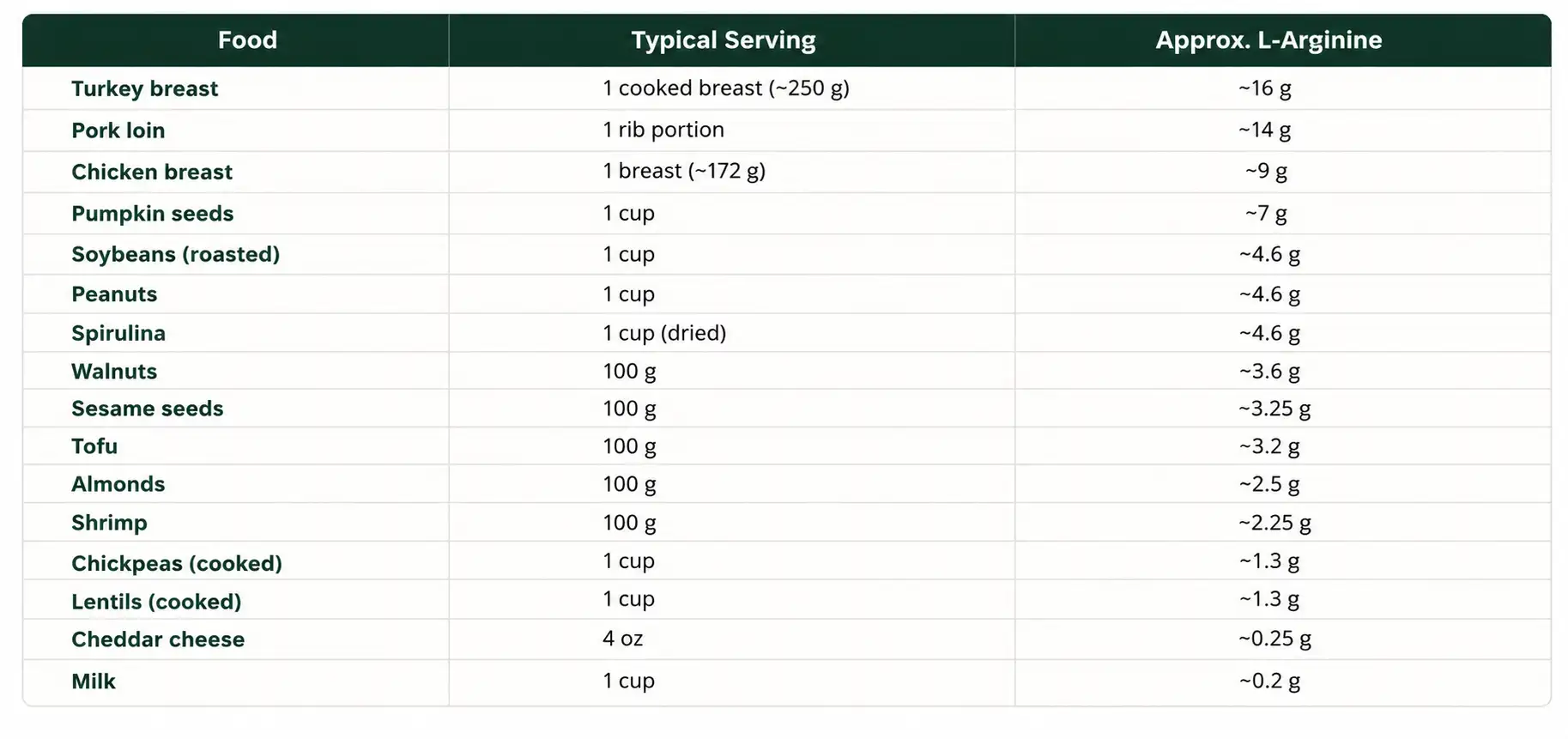
Arginine is a component of protein, so unsurprisingly the richest sources are protein dense foods nuts, seeds, legumes, meat, poultry, fish and dairy. Below is a comparison of commonly available foods and their approximate arginine content.
Values are approximate and drawn from published nutrition data actual content varies by preparation, cut, and brand.
You do not need an exotic diet to get meaningful arginine. A few servings of poultry, fish, nuts, seeds, or legumes across the week cover most people's needs comfortably.
Best Plant-Based Sources of L-Arginine
Plant foods are a genuinely strong source of arginine, which is good news for vegetarians and vegans who sometimes worry unnecessarily about amino acid gaps.
- Pumpkin seeds are one of the most concentrated sources per 100g of any common food, plus a good source of zinc and iron.
- Walnuts arginine + omega 3 fatty acids (ALA), good for a heart healthy eating pattern.
- Peanuts arginine, plus niacin, folate, and vitamin E best eaten in small quantities because they are high in fat.
- Sesame seeds are easy to sprinkle over salads, stir-frys or tahini dressings.
- Soybeans and tofu are a complete plant protein with a strong contribution of arginine, particularly useful for vegans.
- Chickpeas arginine + fibre + plant protein an easy way to get it is in the form of hummus.
- Lentils are a good source of arginine, fibre, especially for vegetarian diets.
- Kidney beans (rajma) a common legume that has a good arginine and protein profile.
- Almonds are a handy snack, best eaten raw or lightly roasted without salt.
- Oats a smaller but steady contributor, and an easy breakfast staple
Best Animal-Based Sources of L-Arginine
Animal proteins tend to deliver large absolute amounts of arginine per serving simply because a chicken breast or turkey portion contains far more total protein than a cup of seeds.
- Turkey and chicken breast are among the highest arginine contributors per serving of any commonly eaten food, along with B vitamins.
- Pork loin a lean cut that’s also arginine-dense.
- Fish (salmon, tuna, sardines, shrimp) arginine alongside omega-3 fats, useful for cardiovascular health more broadly.
- Eggs are a moderate but reliable source, and one of the most versatile proteins in any kitchen.
- Dairy (milk, yogurt, cheese) smaller amounts per serving, but dairy is eaten frequently enough to add up.
Indian Foods Rich in L-Arginine
Most English-language guides to arginine are biased toward Western foods. If you eat a typical Indian or South Asian diet, you may already be getting plenty of this important, inexpensive amino acid from a few everyday staples:
- Chana and kala chana (chickpeas) a legume staple, with a strong arginine and fibre profile.
- Rajma (kidney beans) is a staple North Indian dish, high in arginine.
- Moong dal and urad dal are popular, easy to digest and a good source of plant protein and arginine.
- Soy chunks (nutrela/soya) A rich source of vegetarian protein, good for people who avoid meat.
- Peanuts (moongphali) cheap and available everywhere in India
- Til (sesame seeds) traditionally used in winter foods such as til laddoo and naturally high in arginine.
- Pumpkin seeds (kaddu ke beej) are becoming more available and are one of the most concentrated sources by weight.
- Mixed dal preparations the traditional combination of two or three dals in one meal naturally increases total arginine and protein intake.
A typical Indian vegetarian diet with rotation of dal, chana or rajma on a daily basis, a handful of seeds and dairy (milk, paneer or curd) easily covers arginine needs without any special planning.
Which Food Has the Most L-Arginine?
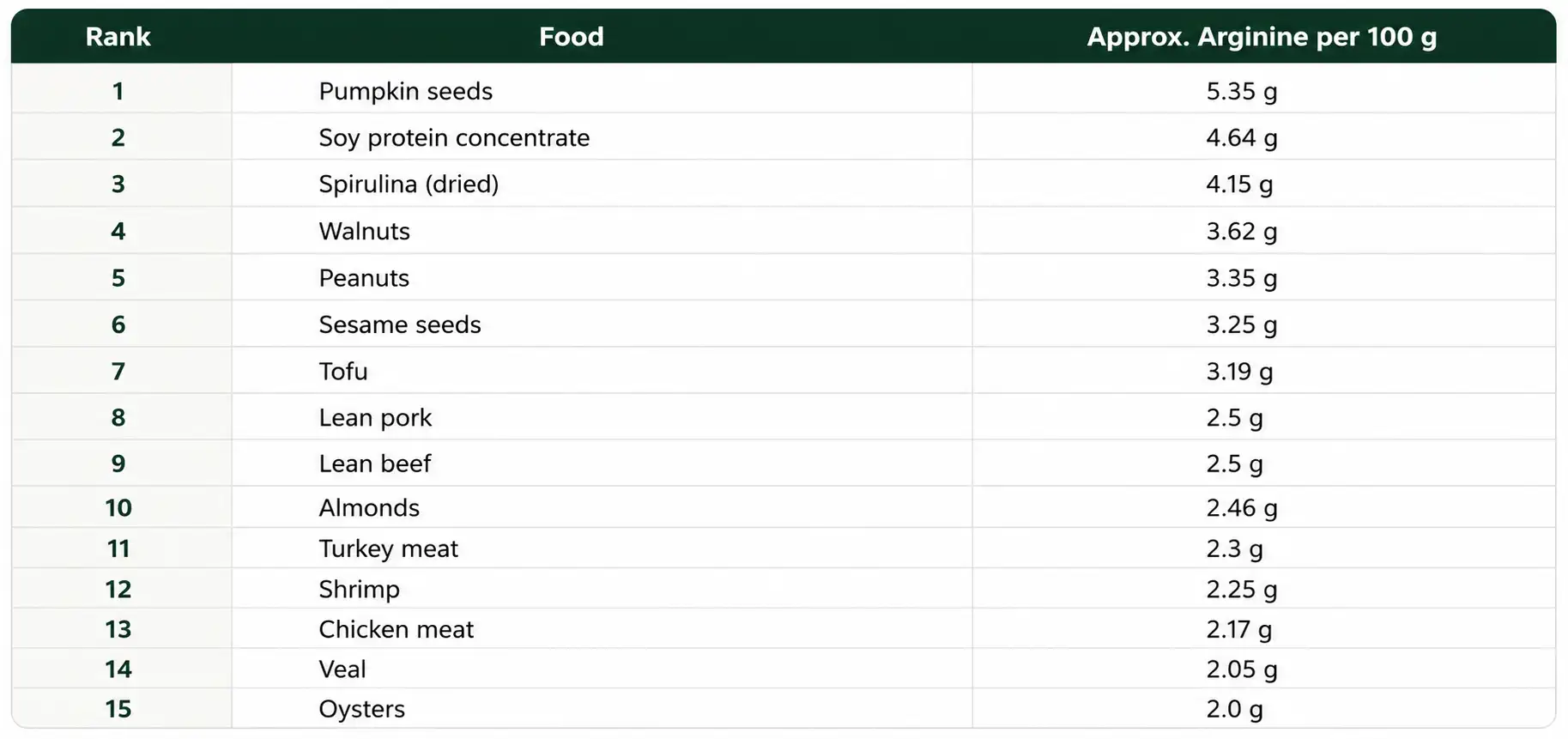
If you are comparing foods by concentration (arginine per 100 g) seeds and nuts top the list. If you are comparing by amount per typical serving, poultry wins because a serving of meat is simply larger and more protein-dense than a serving of seeds.
Top Foods Ranked by Arginine Content (per 100 g)
Gram for gram, pumpkin seeds are consistently cited as one of the richest natural sources of arginine, followed closely by soy-based proteins and spirulina.
One-Day High-Arginine Meal Plan (Vegetarian-Friendly)
This is meant as a practical example not a prescription. Adjust portions to your own needs and if you have a medical condition or take medication, check with your doctor before making significant dietary changes.
- Breakfast: Oats cooked with milk, topped with a spoonful of pumpkin seeds and walnuts.
- Mid-Morning Snack: A small handful of peanuts or almonds.
- Lunch: Moong dal or chana, brown rice, a side of curd, and a mixed vegetable sabzi.
- Evening Snack: Roasted chickpeas or a tahini-based dip with vegetable sticks.
- Dinner: Grilled chicken breast, fish, or tofu with sautéed greens and lentils.
- Optional Bedtime Snack: A glass of milk.
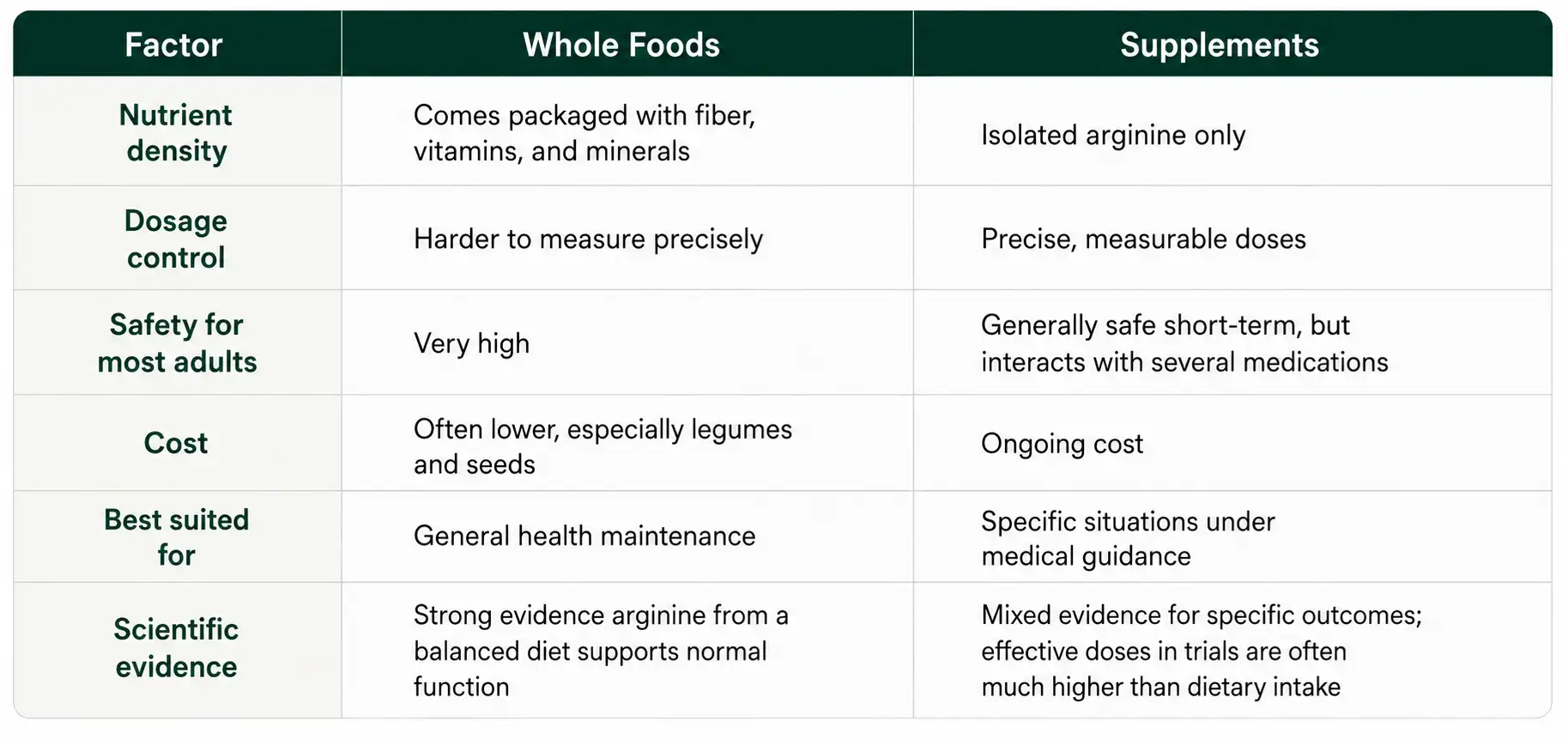
Food vs. Supplements
For most healthy adults, food is the simpler and safer starting point. Supplements are a separate decision that’s best made with a healthcare provider, particularly given arginine’s interactions with blood pressure medications and its unclear safety profile in pregnancy, recent heart attack, and certain other conditions.
Who May Benefit Most From Focusing on Arginine-Rich Foods?
- Athletes and active individuals, given arginine’s role in the nitric oxide pathway relevant to blood flow and recovery.
- Older adults, whose overall protein intake sometimes declines and who may benefit from protein-rich, arginine-containing foods as part of general nutrition.
- People with limited protein variety in their diet, who can use this list to diversify intake, especially on a vegetarian or vegan pattern.
Risks and Considerations
- From food: The intake of arginine from regular foods is essentially without any specific risks, other than the usual risks associated with those foods (e.g. portion control with nuts due to high caloric density).
- From supplements: Arginine supplements can upset the gut and at higher doses cause more serious reactions. They also interact with several classes of drugs including ACE inhibitors, beta-blockers, calcium channel blockers and nitrates.
- Who should be cautious: People who have had a recent heart attack, who are pregnant or breastfeeding, or who have certain metabolic conditions should not take arginine supplements without medical supervision. This warning applies to supplements, not to eating arginine-containing foods as part of a normal diet.
Faq
Which food contains the most L-arginine?
By concentration per 100 g, pumpkin seeds are among the richest sources. By amount per typical serving, turkey and chicken breast provide some of the largest quantities because of their overall protein content.
Are eggs high in arginine?
Eggs contain a moderate, reliable amount of arginine rather than being an especially concentrated source but their overall protein quality makes them a useful everyday contributor.
Are peanuts rich in arginine?
Yes. Peanuts are one of the more concentrated plant sources of arginine, along with useful amounts of niacin, folate, and vitamin E.
Is banana rich in arginine?
No bananas are a poor source of arginine. They are a fruit, not a protein food, so their amino acid content is minimal compared with nuts, seeds, legumes, or animal protein.
Which Indian foods are rich in arginine?
Chana, rajma, moong dal, urad dal, soy chunks, peanuts, til, and pumpkin seeds are all widely available, arginine-rich staples in an Indian diet.
Do vegetarians get enough arginine?
Generally, yes. Legumes, seeds, nuts, soy products, and dairy provide ample arginine, and most vegetarians eating a varied diet don’t need to supplement specifically for this amino acid.
Can food increase nitric oxide naturally?
Arginine-rich foods provide the raw material your body uses to produce nitric oxide, and foods rich in nitrates (like leafy greens and beets) support the pathway from a different angle. Diet is one input among several exercises and overall cardiovascular health also matters.
Do I need a supplement?
Most healthy adults do not need an arginine supplement if they eat a varied diet that includes protein sources regularly. Supplementation is a decision to make with a healthcare provider, particularly for specific medical goals.
Is L-arginine safe?
Getting arginine from food is safe for virtually everyone. Supplemental arginine is generally well tolerated in typical doses for most healthy adults but carries more caution flags, interactions with cardiovascular medications, and contraindications for certain groups.
Which seed has the highest arginine content?
Pumpkin seeds are consistently cited as having one of the highest arginine concentrations among commonly eaten seeds.
Conclusion
L-arginine is a semi-essential amino acid your body both makes and obtains from food, with its best-known role being as a precursor to nitric oxide, a molecule involved in healthy blood flow. Seeds (especially pumpkin seeds), nuts, legumes, soy, poultry, and fish are all strong natural sources, which means vegetarians, vegans, and omnivores alike can meet their needs through ordinary eating patterns. For most healthy adults, a food-first approach rather than supplementation is the simplest, safest way to support adequate arginine intake. Anyone considering a supplement, especially for a specific health goal, should talk with a healthcare provider first, given arginine’s potential interactions with common medications.
This is general nutritional guidance, not a treatment recommendation for any specific condition.
Add comment